Dream

Fast. Good. Cheap.
Pick three.

You were told to pick two because people did the building. Automation does the building now, and your people make the decisions. That changes the maths on all three at once.

Quicker

Days, not sprints.

Work is specified once and executed literally. No hand-off, no interpretation layer, no waiting a day for an answer to a question asked at 5pm.

Why: the constraint moves from typing speed to how fast you can make five decisions.

Higher quality

Thirteen checks. Every change.

Five before anything is built, eight after. Security, regression, duplication, completeness — run identically on every single change, not when someone remembers.

Why: checks are machine-run, so thoroughness costs almost nothing to repeat.

Lower cost

You stop paying for keystrokes.

The expensive part of delivery was always the hours. Automation absorbs the building, so you pay for judgement and accountability instead of headcount.

Why: a small onshore team can run the work an offshore floor used to.

Placeholder
00%faster to production than the previous model
00%lower delivered cost per change
00defects escaped to production

Placeholder figures — real numbers to be supplied before this page goes live.

Why it was ever a tradeoff

Fast, good, cheap — pick two.

That rule was never a law of physics. It was a law of labour. When a person types every line, speed costs quality and quality costs money.

Take the typing out and the three stop competing. The work gets faster because there is no hand-off. It gets better because the checks are automatic. It costs less because you are buying judgement, not hours.

01

Cheap usually means corners cut

Here it means fewer hours bought, with the same thirteen checks on every change regardless.

02

Fast usually means less checking

Here the checking is what makes it fast — bad work is caught before anyone is staffed to it.

03

Good usually means more people

Here it means named people on five decisions, with every approval recorded.

How it works

Five decisions. Everything else is automated.

You

Define

Turn the need into a spec the pipeline executes literally.
Automated

Qualify

Checked for duplication, risk, value and impact before a line is written.
You

Decide

Answer what the pipeline asks. Approve, change, or reject.
Automated

Build & verify

Implemented, built, security-audited and regression-tested.
You

Approve

Confirm it solves the problem, and authorize it into production.
Your decision Runs without you

Products

Command Center for Salesforce.

A grade for your Salesforce org, the findings behind it, and a 90-day plan you can budget. Then hourly and daily monitoring with alerts, so it stays that way.

44

Indicators, five areas

Access and security, data footprint, licensing and spend, user experience, technical health. Scored against a healthy range, explained in plain language.

52

Monitors, hourly and daily

Limits, failed jobs, expiring certificates, login anomalies, admin sprawl, package drift. Alerts by email or Slack when a threshold trips.

0

Changes to your org

Read-only from day one. Every check is a query, never a change, and never a customer or patient record.
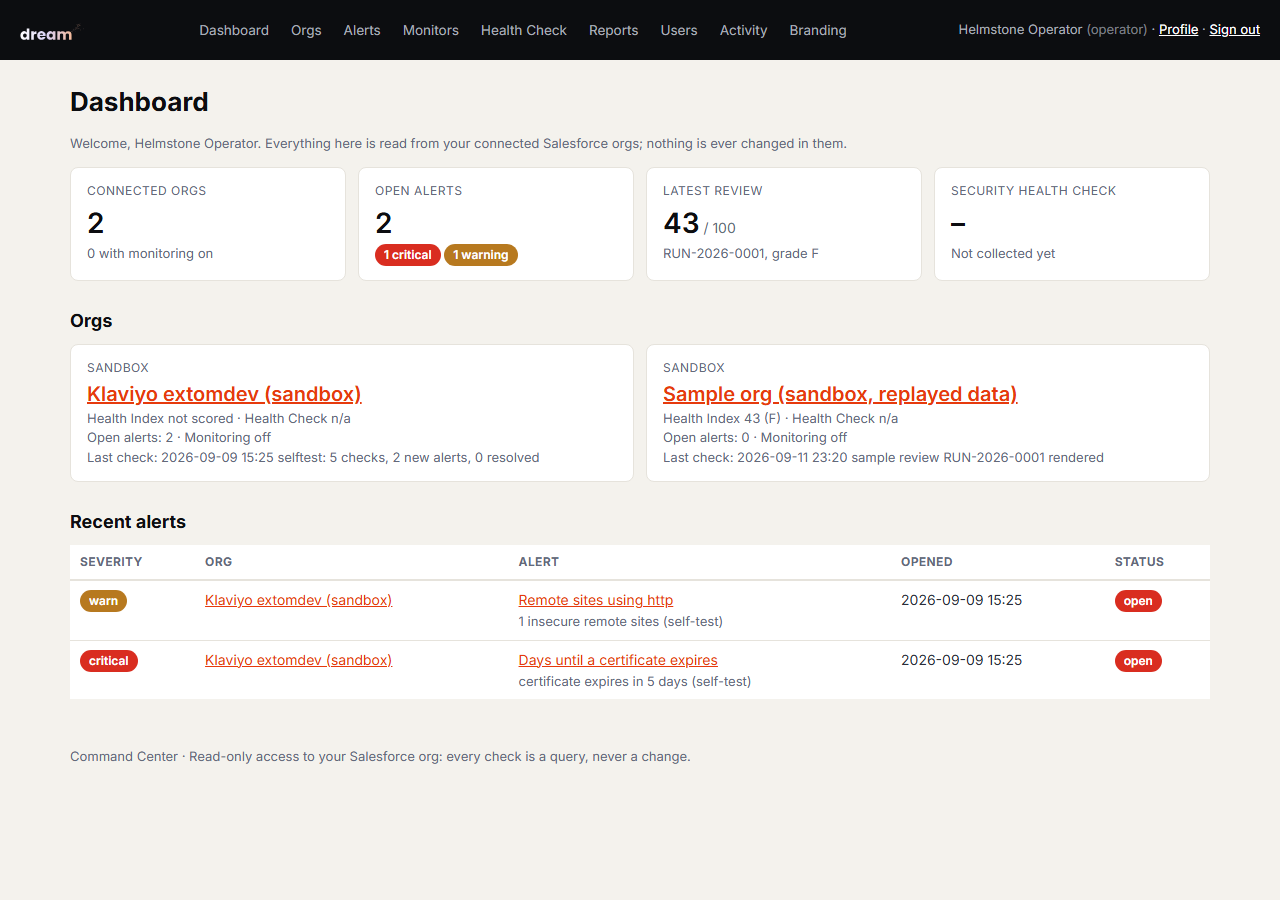
Command Center dashboard showing orgs, open alerts and the latest Org Health Index

Selected work

What this looks like in practice.

Placeholder
Sector · Platform

Project name

One line on what the business needed, and what was in the way.

00%The number that mattered
Placeholder
Sector · Platform

Project name

One line on what the business needed, and what was in the way.

00%The number that mattered
Placeholder
Sector · Platform

Project name

One line on what the business needed, and what was in the way.

00%The number that mattered
Placeholder
Sector · Platform

Project name

One line on what the business needed, and what was in the way.

00%The number that mattered

Placeholder cards — real projects to be supplied before this page goes live.

Onshore delivery

Onshore work, offshore economics.

Offshore was always a price decision, paid for in timezone lag, round-trips and quality variance. Automate the labour and the saving no longer depends on where people sit — so the work comes home without the bill going up.

1

No interpretation layer

The person who understands the business writes the spec the pipeline runs. Nothing is handed off to be interpreted.

2

Answers in your working day

When the pipeline asks a question, the person who can answer it is awake.

3

Accountability has a name

Every approval is recorded against a person, in your jurisdiction, on your terms.

Why us

We run this on our own systems first.

We built our own low-code platform, FlowClick, and we run this delivery model against it every day — in production, with our own money at stake.

So when we quote you faster, better and cheaper at the same time, we are describing something we live with, not something we are selling you.

Put a number on it.

Tell us one piece of work you have queued. We will tell you what it costs and how quickly it ships — and run it end to end so you can check we were right.